2017년 3월 19일 일요일

Natural Sciences and Human Sciences

Are the findings of the human sciences as reliable as those of the natural sciences ?

  • I believe that human sciences are not as reliable as of those of the natural sciences. Natural sciences such as chemistry, physics of biology is approved through hundreds of experiments to reduce the uncertainties. Also, natural sciences can ALWAYS be justified through real life experiences. For example, inertia (natural sciences) can be proved inside a car; when the car stops suddenly, the person move forward as the body wants to continue the movement. However, when human sciences are explored, they are usually done in a certain condition to achieve the conclusions that the researcher wants. This is the reason why there is contrasting views on certain subjects in human sciences. For example, the marshmallow experiment says kids want to get the treat as soon as possible. On the other hand, it might be just because the kids were hungry as they were left in a room for approximately 2 hours without any water or food or toys to play with. If they were given something else to gain their attention, the results might have changed.

To what extent can information in the human sciences be quantified? 


  • Even though human sciences are not so reliable compared to natural sciences, information in the human science is a good resource to refer to. For example, the study of belief healing shows that when people believe in something - such as God(s), the doctor etc - the brain thinks that it will actually cure their illness. This might not be true to everyone, but we can still refer to this. For instance, few years a go, there was a news given that a person with terminal cancer cured himself as his daughters 'lied' to him that his cancer is curing!

To what extent do the knowledge claims of the social sciences apply across different historical periods and cultures?


2017년 3월 2일 목요일

Unpacking TOK essay prompt

"Facts are needed to establish theories but theories are needed to make sense of facts.” Discuss this statement with reference to two areas of knowledge. 

facts pictures에 대한 이미지 검색결과1-Identify (give definition) for key terms.

Facts: something that truly exists or happens : something that has actual existence
Theory: an idea or set of ideas that is intended to explain facts or events

2-Brainstorm specific examples in two AOKs you would use to answer the prompt.

Math: when finding volume using calculus- we don't have specific way of proving it but, by using areas of graph, we can calculate the volume. Furthermore, induction is all about assuming it is true when n=1 and n=k+1.

  • WOK: My own knowledge - I have learnt this in class
Science: It is a known fact that the dinosaurs existed. However, the extinction of dinosaurs have to be explained in order to show it is fact. In order to do this, people came out with theories on how they are extincted.

  • WOK: My own interest on the topic made me research about this

3- What are the assumptions of the claim?

Math: For proving areas of graph, we assume that dx is equal to a constant length that is 'un-measurable'. This is a knowledge I gained from studying maths in class. Additionally, induction makes an assumption that if a statement is true for n=1, n=k and n=k+1, any number will be true. This assumption might be wrong since some numbers might be an 'exception'. Furthermore, some people claim that 1+1 is not equal to 2, and is equal to 1.999999999... just because 8/9=0.888888 so 9/9 should equal to 0.99999... This might sound dumb, but some people believe in it!

Science: when considering dinosaurs, we have to assume in the first place, that the bones discovered are the bones of the dinosaurs. Since no one survived the era of dinosaurs, we can only assume that the bones found are REALLY the bones of the dinosaurs, not just bones of random animals put together.

2017년 2월 20일 월요일

Pseudoscience

What constitutes a scientific claim and can such claims be differentiated from other sorts of claims?


Ways of distorting evidence

  • Names one's 'authority' - their PhDs, certificates... etc
  • They manipulate the results - we have to verify the source of information
  • 'Ethos'
  • Trials are shown
    • However, these are 'predicted', 'controlled' to get the result they want
    • Industry funded trials are 4 times more likely to produce more flattering effects
    • Trials are 'hiding' the results - companies hides the trials that does not show the result they wanted
  • Plasibo effect
    • Believe that a medicine will help me
    • Psychological effect that causes your body to cure oneself
  • Side effects
    • when someone gives more doses of their competitor's drug, it will cause more side effects- makes their product look great
Examples
  • During the first seven days after birth, it is dangerous to expose a child to outdoors or to strangers - pseudoscience : in culture supersitions happens
  • When a man and a woman both have sickle-cell anemia, it is dangerous for them to have children - science
  • Singing while bathing is dangerous - pseudoscience : singing and bathing are very different things and in some cultures they believe that singing in shower can call the devil
  • Bringing bundles of firewood from the farm into the village is dangerous - pseudoscience
  • Smoking cigarettes is dangerous - 

2017년 2월 13일 월요일

Scientific Law, Theory, and Hypothesis

There are three terms in science that defines knowledge. In today's TOK class, we discussed about differences of law, theory, and hypothesis.

Law:
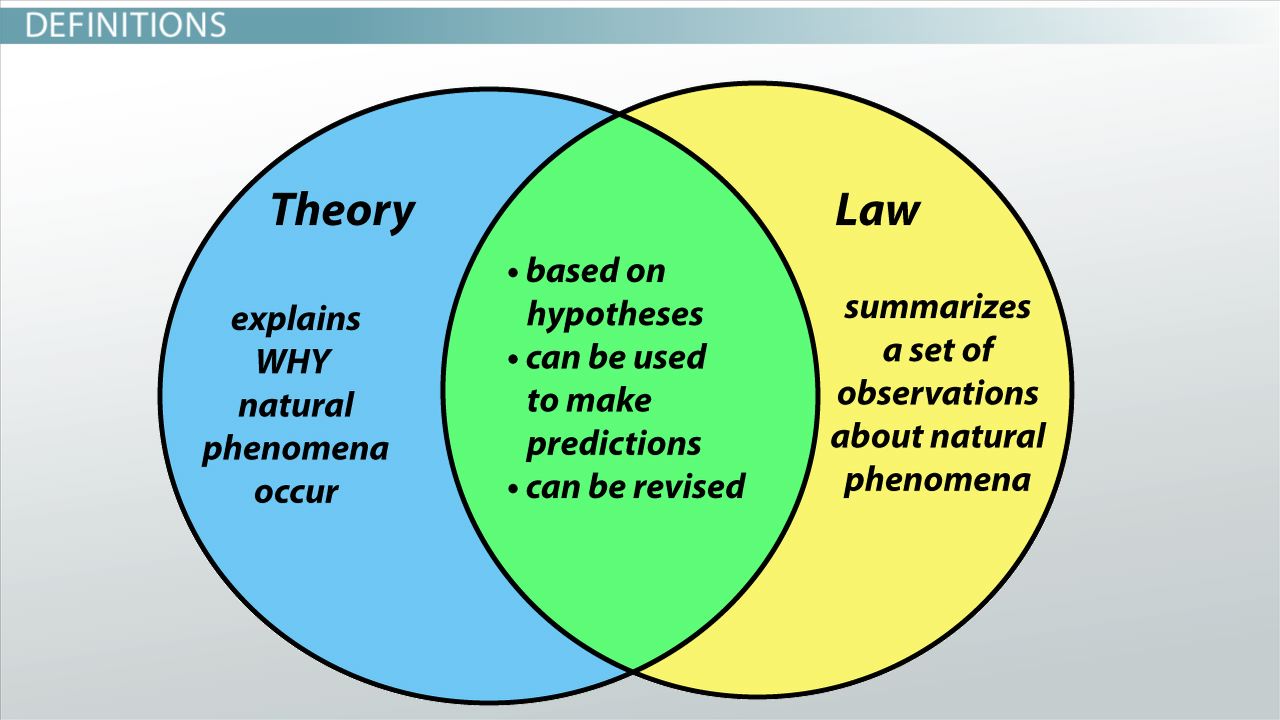
The term law is given to knowledge that are always true. Law cannot ever be proven wrong. However, in any cases, if a 'law' is proven wrong, every theories that were based on the law will be wrong like domino effect. It is accepted universally and all of the theories are based on a law. 
Ex) The law of gravity

Theory

law theory hypothesis에 대한 이미지 검색결과A scientific theory consists of one or more hypotheses that have been supported with repeated testing. Theories are one of the pinnacles of science and are widely accepted in the scientific community as being true. To remain a theory, it must never be shown to be wrong; if it is, the theory is disproven. Theories can also evolve to become more 'complete', accurate theory.
Ex) The Big Bang Theorem

Hypothesis

A hypothesis is a reasonable guess based on what you know or observe. It is always  proven wrong or true. In scientific discovery, hypothesis plays a big role as theory is based on hypothesis and further laws are discovered due to simple hypotheses. 
Ex) If a prisoner learns a work skill while in jail, then he is less likely to commit a crime when he is released. 

2016년 10월 10일 월요일

Senses that remind me of my childhood

Sounds

  • my house phone ringtone
  • cars
  • the sound of bus station
  • the sound of subway station


Smells

  • the hospital smell 
  • my bubble bath
  • grass
  • suncream
  • playdo


Tastes

  • fruit loops
  • ttukbokki (떡볶이)


2016년 10월 7일 금요일

October 6th 2016- TOK response

During the Theory of Knowledge class on October 6th, we started the class with the question of "If a tree falls down and noone is there to here it, would it still make a sound?". This was very confusing and riddling question; at first, I felt 'This is a very stupid question...Of course it does!'. However, when I heard the interpretation from Ms. Fatima, I felt shocked at how some people can approach that question in such a way!

At home, when I thought about that question, I felt if there was someone who can leave eternally, and after the world ends, would that person feel that there is "I" who is alive? The meaning of "I" can only be existence if there is "you" to define "I". 

After the question, we watched a video of "how many balls are there?" and "Back of the Einstein". The "how many balls are there" question seemed unfair to me in a sort of way. The question should define that there was balls already prepared inside. This question had the same context as what is "1+1"? and saying "Oh, by the way there is 2+ before the 1, so the real question is 2+1+1". 

Also when I watched the video of Einstein illusion, I saw the light changing. I thought that video was trying to "look cool" and making simple tricks to fool the audience. I searched up on internet, and it came out that the light effects are the things that was making the shadows.
einstein facial illusion에 대한 이미지 검색결과


Anyways, the class gave me some things to think about:

Would there still be "I" when there is noone to be "you"?
Can we always trust the media and things we get taught in school?